


How to choose the right kitesurfing kite?
Buying Guide - August 2026
Choosing a kitesurf kite means balancing several interacting criteria: your skill level, your build, the wind conditions at your spot, and the riding style you are aiming for. This guide helps you understand the different kite shapes available on the market, estimate the size that suits you, and avoid the most common pitfalls when making a purchase.
In this item
Criteria to define before choosing
The different shapes of kitesurf kites
Quick decision tree
Choosing the right size based on your weight and the wind
Bar, release and leash: the safety chain
Kites and riding programs
Budget and equipment compatibility
Mistakes to avoid
Checklist before buying
FAQ
1. The criteria to define before choosing
Before comparing models, ask yourself two simple questions: what is your actual level, and what do you really want to do on the water (learning, freeride, freestyle, waves, big air)? Two other parameters then help narrow down the choice.
Your weight directly influences the surface area you need: the heavier you are, the more power you need, and therefore more surface area at equal wind. Conversely, a lighter rider needs less surface area to take off and plane.
The wind conditions at your spot matter just as much. A spot with regular, moderate trade winds does not require the same tolerance as a spot with strong, gusty winds like those found in Marseille or Leucate, where a more stable kite that is easier to depower is recommended.
✓ Our advice:
A beginner needs a stable and predictable kite, with progressive power delivery, easy-to-manage depower and accessible relaunch. An experienced freestyler, on the other hand, will look for responsiveness and more direct pull. In between, today's hybrid and delta kites offer a versatile compromise suited to the majority of kiters.
2. The different shapes of kitesurf wings
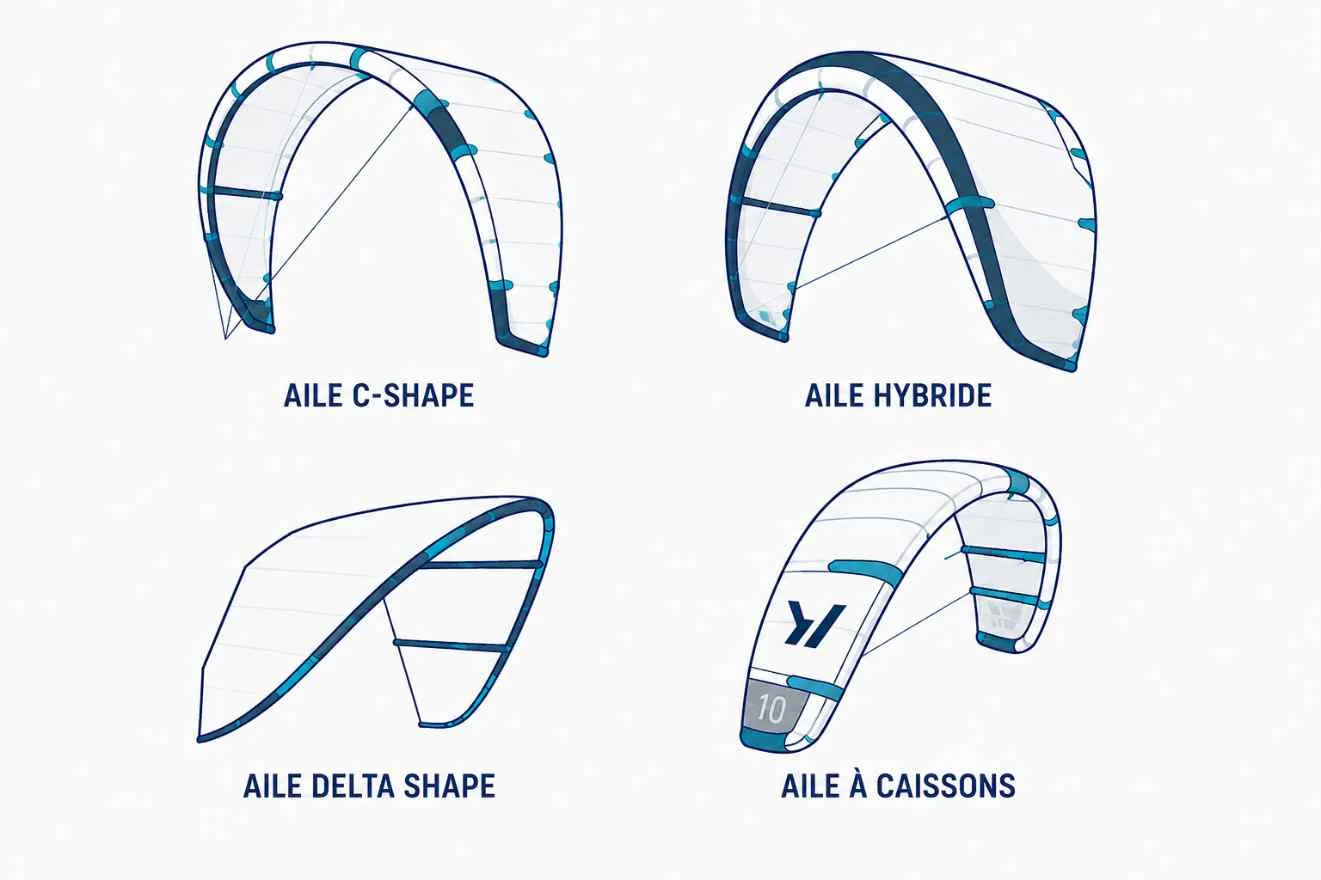
The market today distinguishes four main shape families, to which is added a separate construction family, box kites. Each shape corresponds to a different piloting philosophy. These designations are, however, not fully standardized across brands. Many modern kites combine several concepts — Delta C-Shape, Open-C, Hybrid C, etc. — and their behaviour also depends on their aspect ratio, their bridle, their profile and their construction.
| Shape | Key features | Weak points | Target audience |
|---|---|---|---|
| C-Shape | Good power base, very direct handlebar feel, consistent pull, freestyle pop | Narrower use range, more technical to handle at the top of the wind range, less generous depower | Confirmed freestylers and wake-stylers |
| Hybrid Wings | Wide range of use, significant depower, good balance between pop and versatility | Sensations on the bar less sharp than a pure C-Shape | The great majority of riders, from intermediate to advanced |
| Delta shape | High stability, high depower, easier water relaunch, more direct bar pressure than a standard hybrid kite | Behavior that varies greatly from one brand to another: try before generalizing | Versatile freeride, from advanced beginner to confirmed rider |
| Foil wing (foil) | Excellent performance in light wind, high in-flight stability, no inflation required | More technical water relaunch for some models, historically more land/snow use, to be checked depending on the model for nautica | Light wind, kitefoil, race and riders seeking high aerodynamic efficiency; required level varies depending on the model |
The C-Shape is the original form of kitesurfing: seen from the front, the kite draws a tightly closed C. It offers strong base power and consistent pull, which explains its popularity in freestyle, but it requires a solid technical level to be used comfortably across its full wind range.
Faced with the limitations of the C-Shape in terms of comfort and safety, manufacturers developed in the 2000s a concept known as "bow," featuring a less closed curvature and a bridle system allowing more effective depower. This concept represented a real advancement at the time, but it is now largely obsolete: most brands that offered it have abandoned it in favour of hybrid and delta kites, which retain its advantages with better bar feel. You will therefore find virtually no "bow" kites available new on the current market.
Hybrid kites represent the bulk of the market today. Sitting between different shape concepts, they generally combine good depower capability, a wide range of use and accessible handling.
F-One developed and patented its Delta C-Shape concept, introduced with the Bandit in the late 2000s. This geometry combines the characteristics of a Delta shape and a C-Shape, particularly to offer good depower capability, stability and easier relaunch. Other brands (Duotone with the Evo, notably) have since developed their own kites with a delta or near-delta design.
Foil kites have no inflatable structure: they are stiffened by the wind pressure that enters internal cells. They offer excellent flying qualities and remarkable efficiency in light winds, making them a reference for kitefoil and land or snow-based riding. On water, their use remains more technical and is mainly suited to experienced riders.
✓ Good to know:
There is no universally "better" shape. Two wings of different shapes can target exactly the same use case with different philosophies. The choice is made model by model, ideally after a test or after discussing your actual riding conditions with a specialist retailer.
3. Quick decision tree
✓ The right approach: start from your level and your program, not from the brand.
You are a beginner or progressing rider:
→ Go for a hybrid or delta freeride kite, stable and predictable, with progressive depower and easy relaunch. Make sure the bar and its safety system are fully compatible with the kite.
You practice all-around freeride, with no competition goals:
→ A hybrid or delta kite remains the most comfortable choice throughout an entire season.
You are aiming for freestyle or committed wake style:
→ A high-performance hybrid kite or, if you already have a solid technical level, a C-Shape for pop and direct pull.
You are looking for wave riding or strapless surf:
→ Go for a model specifically designed for "wave/surf" (high drift), generally of hybrid or light delta construction.
You sail mainly in light wind or on a kitefoil:
→ A foil kite can offer excellent efficiency in light wind and on a kitefoil. Certain lightweight inflatable kites specifically designed for light wind or foil also represent an interesting alternative.
4. Choose the right surface according to your weight and the wind
Once the shape has been defined, the next step is to determine the size. Each kite has a wind range stated by the manufacturer, but this range varies considerably from one model and brand to another — sometimes nearly doubling at the upper end of the scale. The table below should therefore only be read as a rough guide, not as data that can be applied to all models.
Your weight affects the equation: the heavier you are, the more surface area you need at an equivalent wind speed; the lighter you are, the less you need. The type and size of the board also strongly influence the choice of kite. A large light wind twintip, a directional board or a foil generally allow you to ride in less power than a small twintip in the same conditions.
Important!
The following table is based on an average weight of 75 kg, for indicative purposes only. It does not replace the official wind range indicated by the manufacturer on your kite's product sheet. These values correspond to approximate figures for twintip use and may vary significantly depending on the board type, the rider's level, current, water conditions, and above all the kite's design.
| Surface area (m²) | Indicative wind range (knots) |
|---|---|
| 6 | 20 to 35 |
| 8 | 18 to 30 |
| 10 | 15 to 28 |
| 12 | 12 to 25 |
| 14 | 8 to 18 |
Convert wind units
Wind strength can be expressed in Beaufort, km/h or knots. 1 knot = 1 nautical mile per hour = 1.852 km/h exactly.
This table is provided for guidance only and should never be your sole decision-making criterion on the water. Always take into account the variations and gusts forecast: an average wind of 25 knots with gusts up to 40 knots can make your wing size unsuitable, even if the average seems to match your table. When in doubt, or if conditions exceed your experience, it is better to refrain from going out or to get out of the water.
5. Bar, width and leash: the safety chain
Each brand develops its own control system: bar, lines, quick release system and leash. Having a thorough understanding of the architecture and operation of this system is not optional: it is a central safety element of kitesurfing practice.
Some kites use a 5th line. Depending on the kite's design, this line may contribute to the safety system, structural integrity and/or facilitate certain relaunch phases. Its role varies from model to model: you should therefore always follow the manufacturer's intended configuration and use a compatible bar.
Manufacturers generally include a brief guide with each kite, containing essential safety information. Take the time to read it in full, and activate your quick release system at least once before your first session, in a calm setting, so you know exactly how it responds.
✓ Please note:
The quick release is the first level of release and must allow the power of the wing to be strongly neutralised according to the system provided by the manufacturer. The safety leash then maintains the connection with the wing; its release mechanism is the last means of separating from it completely if the situation requires it. Check that they are functioning correctly before each session.
6. Wings and navigation programs
All current kite shapes allow, to some extent, for multiple disciplines to be practised. However, each model remains optimised for a specific speciality: freeride, freestyle, wave or big air/race.
All-round freeride: this is the most common discipline, and the one where the versatility of hybrid and delta kites makes the difference. Among the models currently available at specialist retailers, you can find for example the Duotone Rebel or the Duotone Evo, the F-One Bandit, the North Orbit (a brand relaunched in 2020, distinct from its pre-2018 namesake) or the Slingshot Code.
Freestyle and wake style: the most committed riders turn to high-performance hybrid kites or C-Shape kites for direct pull and pop.
Wave and surf-strapless: kites designed specifically for this discipline prioritise drift (controlled drift in the wave) and a smooth, gentle handling.
Big air: these kites prioritise boost, hangtime, upwind ability and control in strong winds. The most big air-oriented models also seek high responsiveness for kiteloops.
Race: race kites seek above all aerodynamic efficiency, speed and performance both upwind and across all points of sail. High-aspect-ratio foil kites hold an important place in this discipline.
✓ Our advice:
Model names evolve quickly in kitesurfing — brand acquisitions, name changes, discontinued lines. Always check the availability and current spec sheet of the model you are interested in rather than relying on an old comparison, including this one a few seasons from now.
7. Budget and hardware compatibility
The price of a new kitesurf kite varies greatly depending on the size, fabric technology and brand positioning: generally expect to pay between €1000 and over €3,000 for the kite alone, excluding the bar and accessories. End-of-collection models can be a good alternative for finding a lower price.
Before purchasing, also check compatibility with your existing equipment: number of lines (4 or 5), safety system architecture, front line split height (low V or high Y), line length and adjustment, and the type of connections between the lines and the kite. If in doubt, use the bar recommended by the manufacturer. Changing brands sometimes means changing the entire bar.
8. Mistakes to avoid
Choosing a wing that is too large "to be more versatile": a wing oversized for your weight and the wind becomes difficult to control in gusts.
Relying solely on the wind range displayed by the manufacturer without taking into account the actual gusts at the spot.
Neglecting to test or gather feedback before buying a highly specialized wing (sharp C-Shape, dedicated wave wing) without having the required skill level.
Buying second-hand equipment without checking its condition: inspect the sail, the seams, the leading edge, the battens, the valves and the wing bridle. If a bar is included, also check the lines, the release system and the safety leash.
Ignore bar/line compatibility when changing brand.
Choosing a wing solely for its performance: a very fast, powerful or technical wing can slow down your progress if its behaviour is not suited to your level and your programme.
9. Pre-purchase checklist
| # | Checkpoint | Validation |
|---|---|---|
| 1 | Navigation level and program clearly defined | ☐ |
| 2 | Rider weight taken into account in surface selection | ☐ |
| 3 | Board type and size taken into account in surface selection | ☐ |
| 4 | Wind range of the usual spot verified (average and gusts) | ☐ |
| 5 | Wing program and behavior suited to my level and practice | ☐ |
| 6 | Number of verified bar lines (4 or 5 lines) | ☐ |
| 7 | Security architecture and V/Y height compatible with the wing | ☐ |
| 8 | Quick release system operation tested | ☐ |
| 9 | Leash checked and in good condition | ☐ |
| 10 | Compatibility with existing bar confirmed in case of brand change | ☐ |
| 11 | Anticipated total budget (wing + possible accessories) | ☐ |
10. FAQ
Choosing your kitesurfing kite requires matching your skill level, your build, and the conditions at your spot rather than relying on a single criterion. If you are unsure between two models or two sizes, our advisors know the equipment in stock and can guide you toward the kite best suited to your riding style.